
Application notes
Application notes and FAQ
Application notes for SoliStat and for the IntelliHose and IntelliThaw lines, all of which use ThermEvolve control.
What is SoliStat?
An industrial-grade, tamper-proof thermostat for DC-powered heating and cooling. Use it to control heaters, fans, pumps or anything else that draws a fair bit of current and needs switching with temperature.
How do I wire a SoliStat?
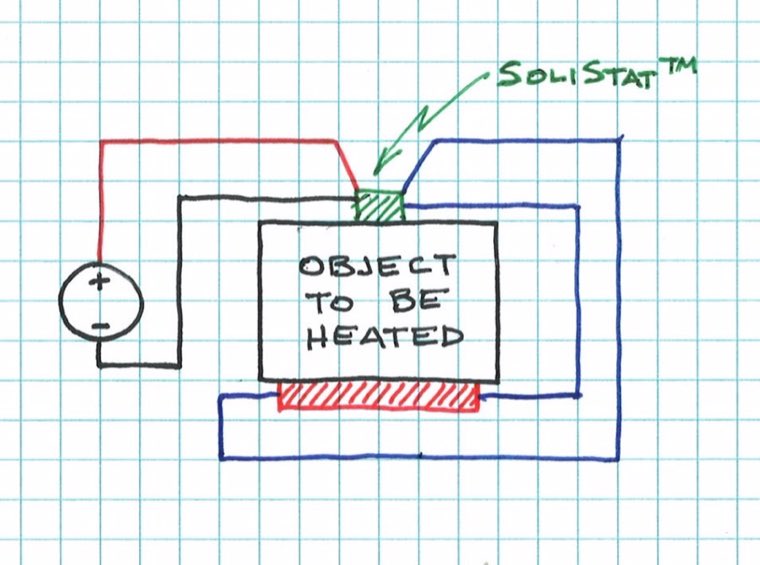
Unlike a two-terminal bimetal thermostat, SoliStat's red wire goes to the positive terminal of the DC source, the black wire to the negative terminal, and the two white wires to the heater (see Fig. 3).
One white wire has a stripe. What is it?
SoliStat 2-10, 2D-5, 2X-15 and 2XD-10 use a high-side switch: the white wire with a black stripe connects through to the negative terminal and the solid white wire is the switched positive. SoliStat 2-20 and 2X-30 use a low-side switch: the white wire with a red stripe connects through to the positive terminal and the solid white wire is the switched negative. This matters for polarity-sensitive loads such as pumps.
What are the two lighter-gauge wires?
The green 20 AWG wire is the system bypass line and the black 20 AWG wire is connected internally to the negative terminal. Connect green to 0 V to stop SoliStat operating; connect it to anything above 1.5 V, up to the supply voltage, to put it back in operating mode.
Why would I use bypass mode?
For example, equipment used ten hours a day on weekdays can run the heater overnight and still start, but not over a whole weekend; a switch to the bypass line stops the drain. Or, if heater current plus everything else exceeds what the system can supply, the engine control unit can hold the bypass line low during those periods.
My system is 28 V. Is that a problem for a 6-24 V SoliStat?
No. Its circuitry withstands continuous voltages a bit higher than 28 V and has strong transient immunity. The SoliStat HV-20 likewise withstands a bit above 48 V. For 72 V, the SoliStat XHV is under development.
Is SoliStat used in ThermEvolve products?
SoliStat 2XD-10 is used in several IntelliHose models. Other ThermEvolve products use circuitry and algorithms based on SoliStat's.
Which standard ThermEvolve products are there?
IntelliThaw jackets for the MotoRad MO-75 crankcase breather cap and Mann+Hummel ProVent 200 and ProVent 400 filters, and three IntelliHose models for Case bulldozers. These jackets were developed independently, at the request of equipment users with cold-weather problems on those parts.
I'm not an OEM, but a few machines give me trouble in winter. What can you do?
All standard products are available from our distributors. A distributor may also solve the problem with a SoliStat and one of the heaters they sell. If not, they forward the details and we decide whether to develop an IntelliThaw jacket for it.
Can you make a heated version of my breather hose?
Yes. IntelliHose can be made in small quantities, even a single piece, fairly quickly. Give your distributor the hose details. The best time to quote is March to the end of July; from late August to early March, quotes can take a couple of weeks and a hose that ships in two days in July might take four weeks in November.
How long until I get first articles of an IntelliThaw jacket?
With 3D models (native SolidWorks preferred, STEP accepted), testable hand-built prototypes in as little as two weeks; molded parts in as little as eight weeks, depending on part size and time of year.
How much power do IntelliThaw and IntelliHose use?
The IntelliThaw MO-75 uses 60 W at startup and the PV200 190 W. The IntelliHose DEF hoses use 200 W at startup. Once the setpoint is reached, average consumption drops to a fraction of that.
Why is startup power that high?
The customers who asked for these products specified a −40°F starting temperature and 5 minutes or less to operating temperature, with no limit on current draw. Holding a setpoint always takes far less power than reaching it.
What does average power consumption mean here?
The control is ON/OFF: the heater runs at full power below the setpoint and switches off above it. Averaged over an hour, the IntelliThaw PV200 uses about 4 W at −10°C, 8 W at −30°C and 10 W at −50°C after warm-up. We are happy to share test data.
Do all IntelliHoses use 200 W?
No. The standard hoses were designed for 10 W per foot, which thaws DEF from −40°F in about three and a half minutes. Crankcase ventilation hoses generally work at that level too; one proprietary ventilator hose in development uses 60 W per foot at the customer's request.
Do I need to reprogram my engine control unit?
No. IntelliThaw and IntelliHose work on their own. Connect them to the equipment's power, switched or unswitched.
How do I know when it's at temperature?
Proprietary designs come with test data showing warm-up times. A SETPOINT READY line is available as an option, to an engine control unit, relay or LED.
What other control lines are available?
SYSTEM BYPASS (as on SoliStat); TEST MODE / ALTERNATE SETPOINT, which raises the setpoint so you can check the heater works in summer; and a SYSTEM ERROR output to an engine control unit or LED.
Printable documents
- SoliStat DC thermostats: introduction and specifications (PDF)
- ThermEvolve technology product sheet (PDF)
- Generic test data packet (PDF)
- ThermEvolve technical function (PDF)
- Test data from 6 mm DEF hose (PDF)
The PDFs stay on engenity.com; link them here at go-live.
Request a quote or a sample
Prefer to talk? Toll-free (844) 288-2590, local (612) 767-9590. To order standard parts, go through a distributor.
- The part: component or hose manufacturer and model number, and length.
- Power: supply voltage and the current the heater or load draws.
- Temperatures and quantity: setpoints you need and how many.